
What’s inside this article:
- Protecting the Agency Standing: Why the storyboard is your first (and most important) client trust-test.
- Must-Have #4: Why ferocious speed is the only way to safeguard a modern production timeline.
- The Case Study: IF, Directed by John Krasinski
- Must-Have #5: How a killer portfolio signals elite partnership to your brand.
Reducing Production Risk with Cinematic Accuracy
In high-stakes production, the storyboard is more than just a sketch; it is the first time your client sees their investment come to life.
If that visual blueprint is shaky, slow, or technically flawed, it’s not just the artist who looks unprepared; it’s the agency’s and director’s reputation on the line.
To protect that standing, you need an artist whose range covers more than just style. You need an artist who can bridge the gap between a frantic timeline and a flawless technical execution, with storytelling skills that will enhance the brand.
Must-Have #4: Reliability & Ferocious Speed
In commercial production, “fast” is a baseline requirement. You need someone who consistently outpaces your most aggressive deadlines. But speed is only valuable if it’s technically accurate. A top-tier artist moves with high-speed precision, locking in the spatial logic and camera framing required to keep the production momentum moving forward and protect your VFX pipeline.
But for an agency, speed is more than just hitting a deadline. It’s about the ability to iterate in front of a client while maintaining total creative control. You don’t want an artist who merely draws fast, but a cinematic strategist who thinks fast.
Speed is only valuable if it’s technically accurate. Speed without accuracy is a liability.
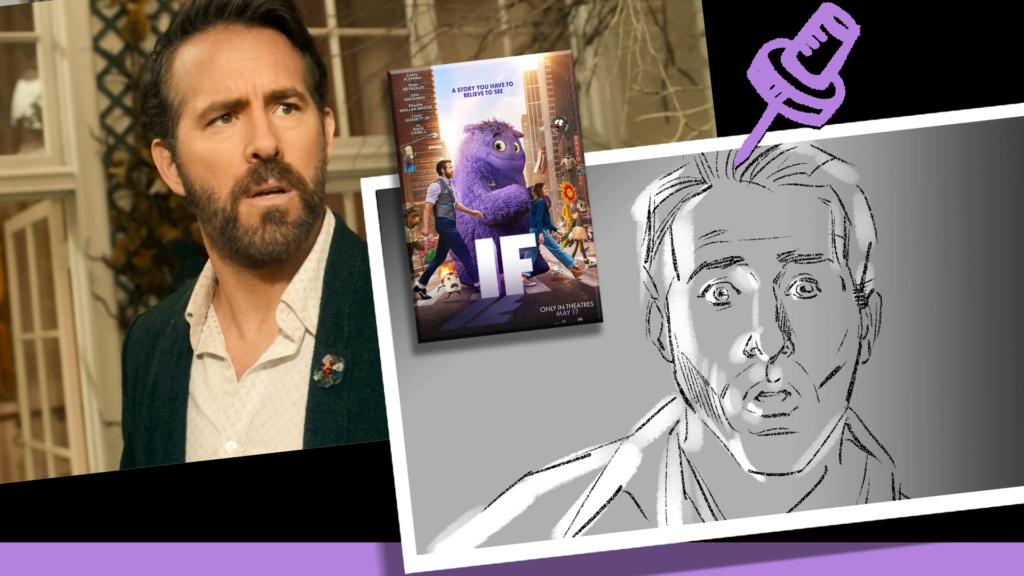
Case Study: Movie: IF directed by John Krasinski
When the SJS team storyboarded the (hybrid VFX) feature IF, we weren’t just drawing scenes; we were building the technical roadmap for a world where imaginary characters had to feel physically real. The production timeline left no room for rough guesses. John and Joe were on Zoom calls, breaking down massive effects-heavy sequences involving Ryan Reynolds, shooting stars, invisible characters, a giant purple creature, and a flame-spewing dragon, all of it needing to be executed at high speed and with absolute spatial clarity.
Our ability to move quickly without sacrificing structure allowed the production to lock camera framing, eyelines, staging, and VFX logic before a single pixel was rendered. That level of reliability protects an agency’s standing because the storyboard process should accelerate production, not create expensive downstream fixes in the VFX pipeline.
Studios want boards delivered at lightning speed, but speed alone isn’t enough. If the boards are fast but technically unreliable, credibility suffers. Strong storyboards must do three things simultaneously: sell the idea, communicate the story clearly, and function immediately once the production hits the set.
Must-Have #5: A Killer Portfolio
Speed alone isn’t enough; you need proof. Has this artist worked on projects you recognize? With agencies and brands that match your level? Look for range, case studies, and a style that actually resonates with your vision.
A killer portfolio is a signal to your client that you only bring elite partners to the table. It proves the artist has handled the logistical pressures of top-tier campaigns before. When you hire based on pedigree, you aren’t just hiring a hand; you are hiring a track record that reinforces your agency’s authority.
The Bottom Line for EPs:
When you hire a storyboard artist, you are essentially buying an insurance policy on your production schedule. Your storyboard artist is the guardian of your agency’s reputation during pre-production. An artist with a limited range or slow delivery creates a “trust gap” between you and your client. By demanding ferocious speed and a portfolio that matches your agency’s level, you ensure that the visual blueprint is a source of confidence, not a source of risk.
FAQ: Range, Speed, and Reputation
How does an artist’s “range” affect an agency’s reputation?
If an artist can only do “one style” or can’t handle technical VFX logic, the agency is forced to hire multiple people or fix mistakes in post-production. An artist with true range handles every stage, from rough thumbnails to high-res finals, keeping the agency looking efficient and prepared.
What should an Executive Producer look for in a storyboard portfolio?
Beyond just style, look for production complexity. A killer portfolio proves the artist has collaborated with high-level brands and directors, demonstrating an inherent understanding of camera movement, lighting, and the realities of working on set.
How do premium storyboards protect a production budget?
Pre-production is the least expensive phase to make changes. An elite artist acts as a pressure test for your shoot. They help identify logistical issues on paper, long before you are paying full day-rates for a massive crew and equipment.
Catch Up on the Series
Edition 1: The Creative Whirlwind (Must-Have #1)
Edition 2: Storytelling & Illustration Range (Must-Haves #2 & #3)
Edition 4: Coming Soon! In our series finale, we tackle the final two Must-Haves: #6 and #7.
Ready to protect your next shoot?
Protect your next production’s timeline. Schedule a 30-minute call with Yamilca to discuss your upcoming project’s technical requirements.
 Producers…Hire the right storyboard artist (or regret it later).
 Directors…Which Style Storyboard Do You Prefer?