
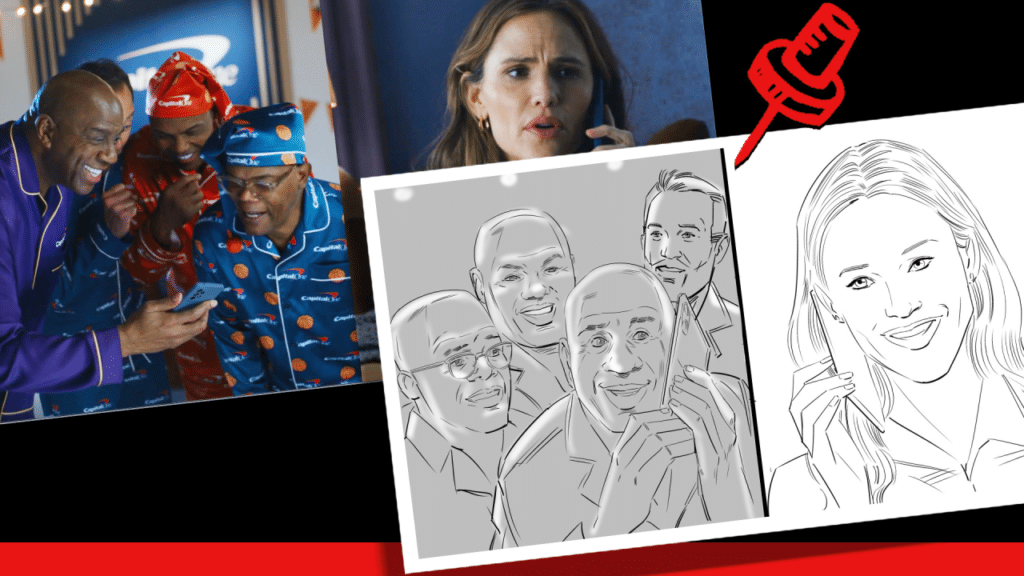
In high-stakes commercial production, the difference between a “pretty drawing” and a “producible frame” can be the difference between a successful shoot and a budget catastrophe.
What’s inside this article:
- Designing comedy you can actually shoot: Why timing and “reaction beats” are more important than pretty drawings.
- The collapse of the isolated frame: Why an amazing illustration portfolio can still fail in the edit bay.
- Visual efficiency: Knowing when to use loose thumbnails vs. high-polish agency frames to protect your timeline.
While many illustrators possess immense artistic talent, a true storyboard artist is a cinematic strategist. This edition of our “7 Must-Haves” series breaks down the critical distinction between pure illustration and storytelling fundamentals, using our “March Madness” collaboration with director Bryan Buckley to demonstrate how the right visual foundation protects your production’s scale, comedy, and contingency budget.
In the first part of this series, we talked about surviving the “Creative Whirlwind” of pre-production by hiring a thinking brain, not just a pair of hands. Read Part 1 here
Today, we are diving into the next two essentials of our 7 Must-Haves when hiring a storyboard artist: Storytelling Fundamentals and Illustration Range.
For Executive Producers and Directors, understanding the difference between a great illustrator and a great storyboard artist is what separates a shoot that moves like clockwork from one that grinds to a halt.
Must-Have #2: Storytelling Fundamentals (Designing Comedy You Can Shoot)
In production, isolated great frames are useless if the sequence collapses in the edit.
We see this happen all the time when a production hires someone based purely on an illustration portfolio. The drawings look incredible on their own, but when you put them side-by-side, there is no connective tissue. The framing doesn’t lead the eye, or worse, the sequence literally won’t cut together in the edit bay.
Case Study: Capital One “March Madness”
When we worked with Director Bryan Buckley and Producer Matt Lefebvre on the “Legends” campaign, we were dealing with a house full of icons: Samuel L. Jackson, Magic Johnson, Charles Barkley, Jennifer Garner, and Caitlin Clark.
In a spot with that much star power and scale, the logistics alone can create chaos.
Much of this campaign’s comedy lives in the reactions. If you don’t design the space for those reaction beats in the storyboards, you risk losing what makes it work on set. A true storyboard artist understands film language and anticipates the editor’s needs before the camera even rolls.
A director like Bryan Buckley is a master of tone and timing. For ‘Legends,’ mapping those beats in advance meant the crew knew exactly what was needed, capturing every performance without wasting a single second of set time.
Capital One: Sleepover spot: Watch how our boards translated directly to the screen to protect the comedy and the budget
Must-Have #3: Illustration Range (Visual Efficiency)
Range isn’t about being able to draw both cartoons and photorealism. In commercial production, the range is about visual efficiency.
Range means moving between strong visual contrasts and clear reaction moments at a very fast turnaround. A seasoned artist knows when fast, loose thumbnails are needed for quick director iteration, and when highly polished frames are required to sell the vibe to the agency.
In the Capital One spot, the range allowed us to match the specific tone under immense pressure, providing a shared language for the director, producers, agency, and crew.
The Bottom Line for EPs
When you are reviewing an artist’s reel, don’t just look for great art. Look for great filmmaking.
Catching a lens mismatch or a timing issue during the storyboard phase costs you nothing. Discovering it while five A-list celebrities and a 50-person crew are standing around on set? That costs you your contingency budget, which is a storyboard artist’s real job, preventing expensive surprises.
Frequently Asked Questions
What is the main difference between an illustrator and a storyboard artist?
An illustrator focuses on creating a single, high-quality aesthetic image. A storyboard artist focuses on “film language,” ensuring sequences cut together logically in the edit, lead the viewer’s eye, and provide a practical blueprint for the director and crew to execute on set.
Why are storytelling fundamentals important for storyboards?
Without storytelling fundamentals, a sequence may look good as individual frames but fail to “work” on set. A seasoned storyboard artist understands timing, lens choices, and editorial beats, ensuring the visual foundation translates directly to a shootable sequence.
What does “illustration range” mean in commercial production?
In the commercial world, range is about visual efficiency. It means the ability to pivot between fast, loose iterations for a director and highly polished frames for an agency presentation, all while maintaining the specific tone and scale of the project.
How can a storyboard artist help protect a production budget?
By identifying timing issues, lens mismatches, or logistical hurdles during the storyboard phase, you can solve problems when they cost $0. A storyboard artist prevents expensive surprises that occur when a 50-person crew is standing around on set trying to figure out a sequence that doesn’t cut.
What’s Next…
The 7 Must-Have Series:
Part 1: Surviving the Creative Whirlwind,
Part 3: Why Your Agency’s Reputation Depends on Your Artist Range
Part 4: How to Protect Your Production Budget
Ready to protect your next shoot?
Schedule a 30-minute call with Yamilca to discuss your upcoming project needs and ensure your next production is as efficient as possible, while protecting your contingency budget and executing your director’s vision.
 Producers…Hire the right storyboard artist (or regret it later).
 Directors…Which Style Storyboard Do You Prefer?